The next useful smart home upgrade may be something you barely notice: a room that knows when to keep the lights on. Presence sensing is becoming an important part of the conversation about smart home installation in North Georgia, especially where homeowners want automation to respond without repeated voice commands.
For late 2026 and 2027 planning, the opportunity is more precise room behavior. The challenge is making that behavior fit real life. A sensor that can detect someone sitting still is useful only when its placement, integration, and programming produce the right result.
Presence sensing versus motion detection
Traditional motion-triggered lighting is familiar: enter a space, trigger a sensor, and let a timer eventually turn the lights off. That can suit a passageway. A reading chair or home office introduces a different problem because someone may remain relatively still for a long time.
Radar-based presence sensors are designed to detect small movements associated with occupancy. Some products can divide a space into zones, allowing a system to distinguish areas of one open room. These are product-dependent capabilities, not a guarantee of perfect detection in every layout.
The question to ask is specific: can the proposed installation keep the reading light on while someone reads, without turning on unrelated lights in the kitchen?
What is emerging in presence-sensing technology?
Newer sensors bring more detailed spatial information into the automation conversation. Aqara's FP400 product documentation, for example, describes mmWave sensing without capturing visual content and different capabilities depending on setup. It warns that direct third-party Matter-over-Thread setup is limited to whole-area occupancy without custom zones. That distinction illustrates why the connection method matters as much as the product name. Review Aqara's FP400 feature and setup notes.
This is a technology example, not an endorsement of a particular sensor for every Ridge installation. Before choosing hardware, confirm which events the intended control system can actually receive. A detailed zone map in one manufacturer's app does not prove that another platform can use those same zones.
Design the room behavior before choosing the sensor
Write a short description of how each space should behave. A kitchen may need brighter task lighting when occupied after dark. A living room may need to preserve a manually selected movie scene. A hallway may need a gentle nighttime level instead of the daytime setting.
Good programming considers several signals together: presence, available light, time, and the current scene. It also defines an appropriate delay before changing an empty room. A brief trip to another room should not necessarily reset the entire experience.
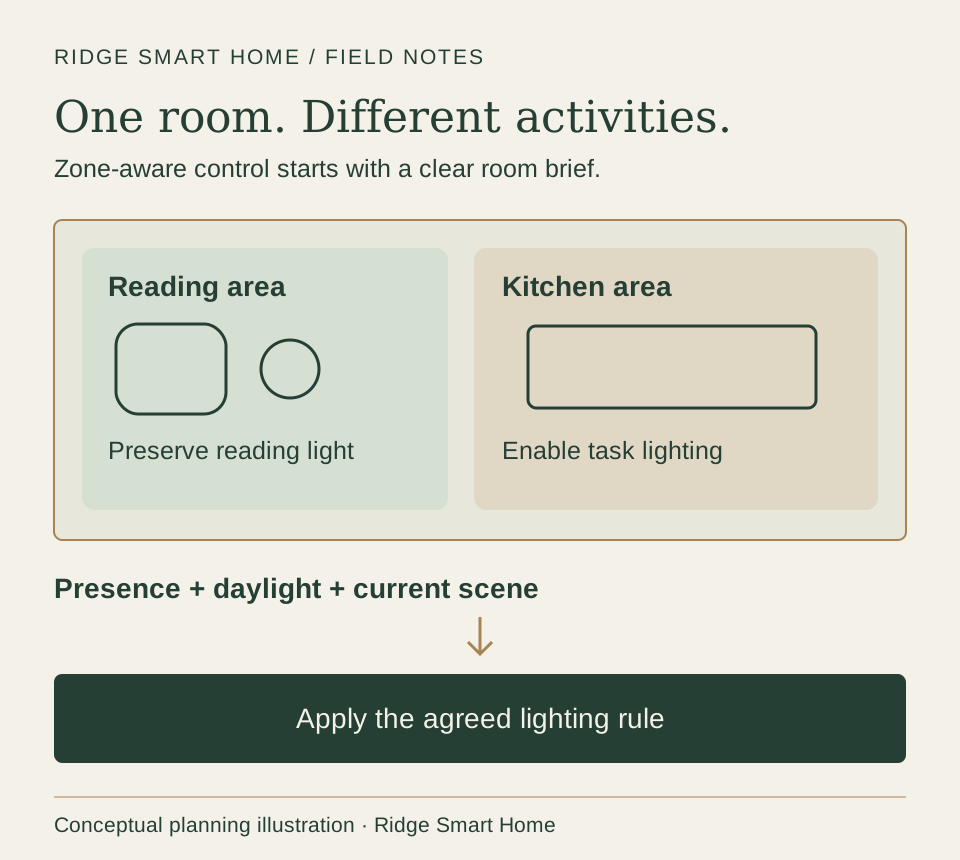
Conceptual zones for an open room. Actual coverage and supported zones depend on the sensor, installation, and control platform.
Where presence sensing can help in North Georgia
Reading rooms in Ellijay and Blue Ridge
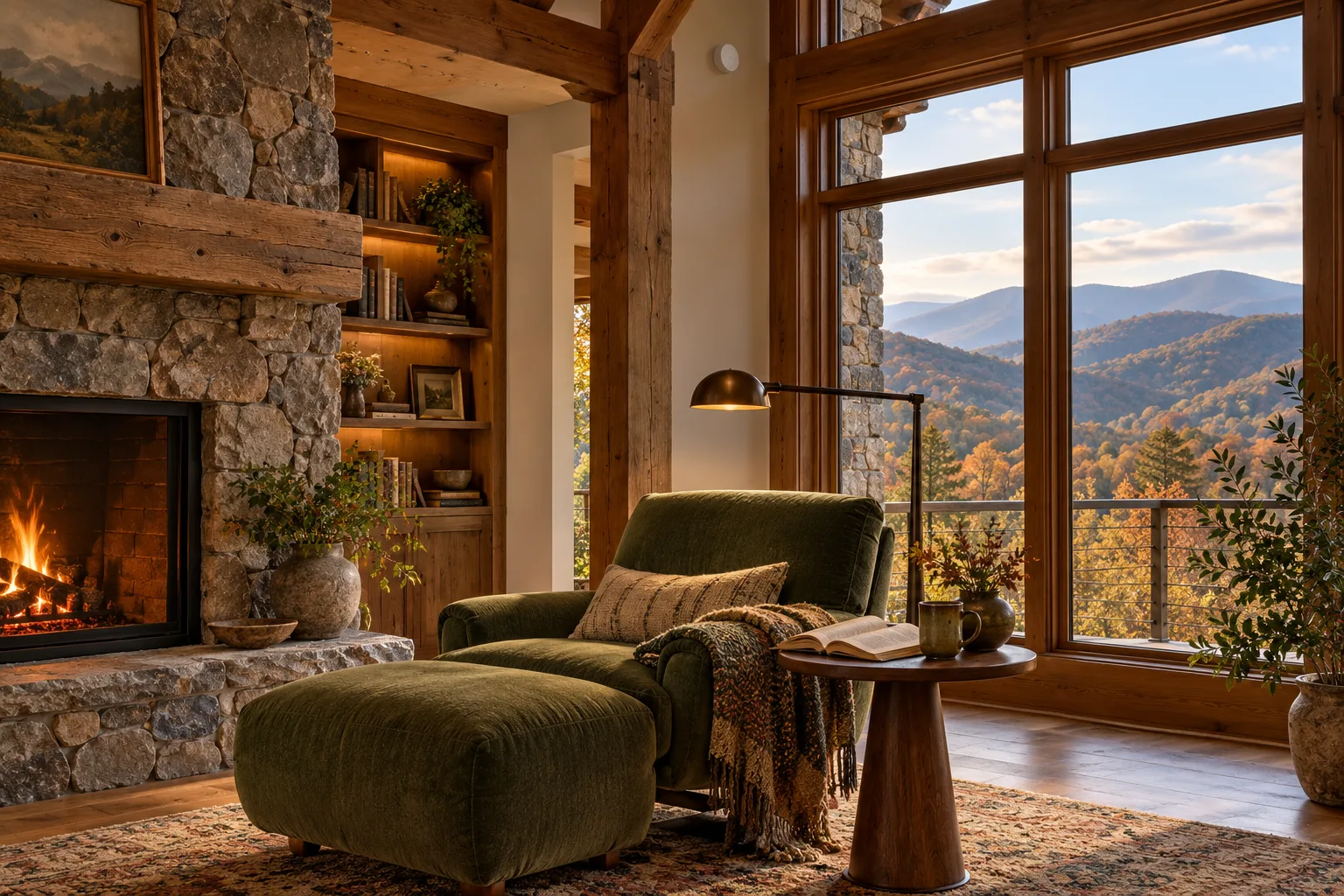
A mountain home often has spaces intended for slowing down. In Ellijay or Blue Ridge, a reading area is a useful place to evaluate whether a sensor recognizes someone seated quietly. Test the actual chair position and ordinary activity. Keep a manual reading scene available so the homeowner can choose a steady light level.
Open living spaces in Canton and Woodstock
In a suburban home with connected kitchen, dining, and living areas, one whole-room occupancy signal may be too broad. A zoned design can be considered where the equipment and integration support it. Someone preparing dinner should not automatically disrupt another person watching a film. Ridge's lighting and motorized shade design starts with those separate activities.
Offices and flexible rooms in Kennesaw and Jasper
For a home office, test typing, reading, and a long call rather than only walking through the doorway. A guest room or multipurpose room also needs an obvious way to pause automatic behavior. In Jasper, as elsewhere, the right approach depends on the property's layout and use rather than the city name alone.
How to commission a presence sensor properly
An installation should be tested with furniture in place and normal household activity underway. Follow the selected manufacturer's mounting guidance, then test the boundaries you expect the system to respect. Check adjacent spaces, moving curtains, fans, pets, and other conditions relevant to the room. These are commissioning checks, not assumptions that every sensor reacts the same way.
Record a few pass-or-fail scenarios:
- A seated person keeps the intended light scene active.
- Someone outside the intended zone does not trigger an unrelated room.
- A manual light adjustment behaves as agreed.
- A short absence does not create an annoying reset.
- Loss of the sensor leaves a usable way to control the room.
Review the behavior after living with it. A small adjustment to sensitivity, zoning, or timing can matter more than adding another device.
Does presence sensing need a camera or AI?
Not necessarily. Radar-based sensing can provide occupancy information without a camera, while programmed rules can act on that information without a conversational AI assistant. Privacy still deserves attention: ask what occupancy information is recorded, where it goes, and who can access it.
Can presence sensors reduce energy use?
They can help avoid leaving selected lights on unnecessarily, but savings depend on lighting loads, schedules, occupancy, and the previous behavior of the household. No percentage should be promised without a meaningful comparison. Start with comfort and reliable control, then assess energy performance using actual measurements where available.
Can sensors be added to an existing smart home?
Often a focused room upgrade is worth evaluating, but compatibility must be checked first. Confirm power needs, connection method, controller support, and which occupancy events are exposed. Our Matter planning guide explains why a compatibility label is only the beginning of that discussion.
Talk with Ridge about a room-by-room automation plan. A considered installation makes the technology recede into the background while keeping control close at hand.
Technology references checked October 7, 2026. Product examples illustrate design considerations; specifications and integration support should be verified for each project.