A smart home should make the ordinary moments easier: arriving after dinner, lowering the lights, or making the guest room comfortable. Compatibility matters because it determines whether those moments feel like one experience—or a collection of separate apps.
For homeowners planning a late-2026 renovation or a 2027 installation in North Georgia, Matter deserves a place in the conversation. It should also be discussed with precision. A standard can create useful possibilities without making every device, platform, and feature interchangeable.
What changed in 2026
The Connectivity Standards Alliance released Matter 1.6 on June 17, 2026. Its additions include NFC-based commissioning, a Joint Fabric approach to shared device management across participating controllers, and thermostat suggestions that can account for user preferences. These changes concern setup and coordination rather than a new collection of device categories. The Alliance also makes clear that manufacturers and platforms will adopt capabilities on their own schedules. Read the official Matter 1.6 announcement.
The practical implication for a purchase is simple: ask what the exact product supports today. An announcement about the standard is not confirmation that the thermostat, controller, or software version in your proposal implements it.
Start with the experience, then check the connection
Imagine a renovation in Woodstock with a new kitchen, motorized shades, and lighting that should change together when dinner begins. Write down that experience before making a device list. Which lights change? Do the shades close fully or only reduce glare? Should a wall button work for guests who have never opened the app?
Then verify each part of the proposed system against those requirements. A device appearing in an app is only the first check. The useful question is whether the integration exposes the particular controls, feedback, and automation behavior your household needs.
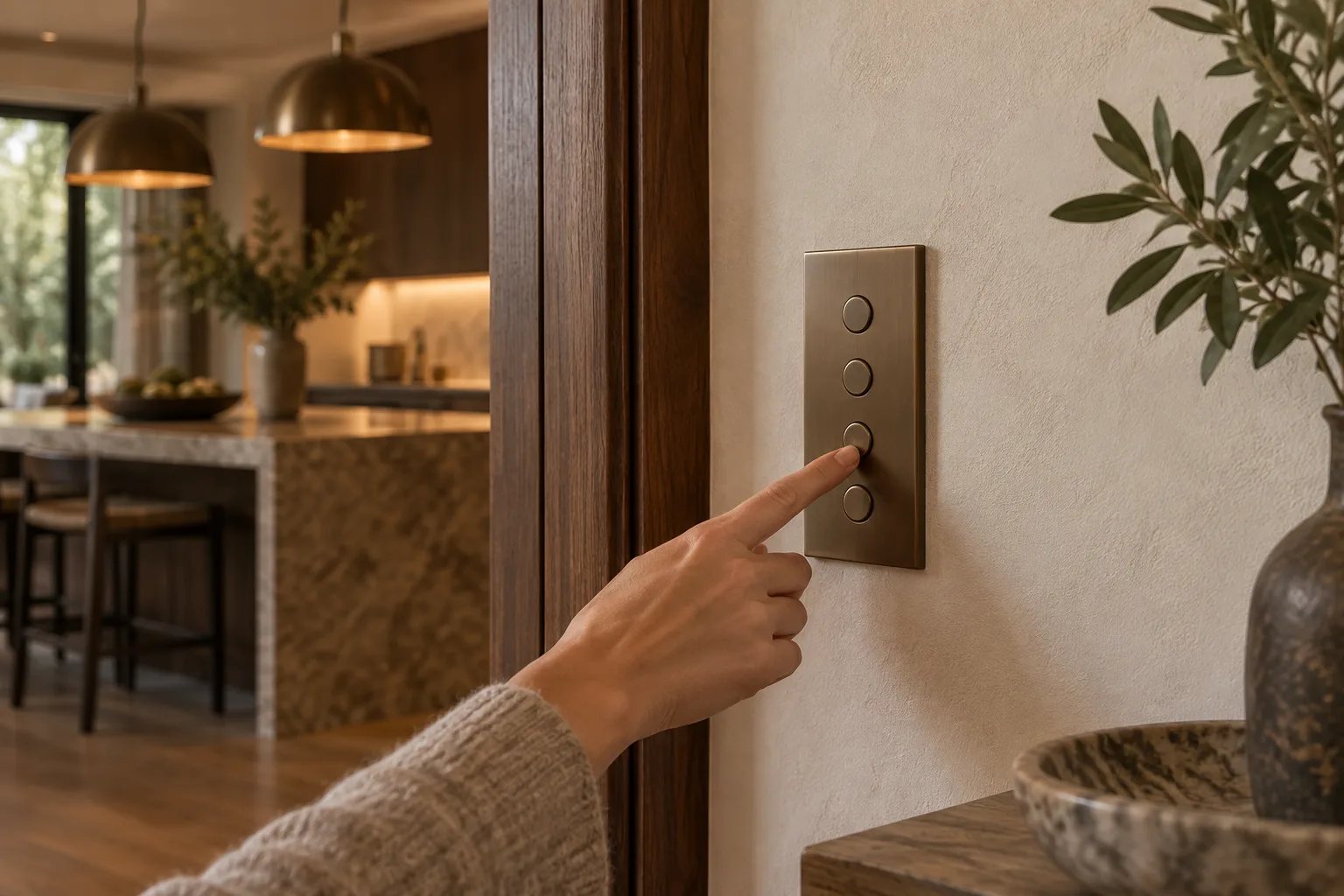 Illustrative design study: everyday controls should remain clear even when the technology behind them becomes more capable.
A compatibility brief worth asking for
For a custom home in Canton or Kennesaw, we recommend turning compatibility into a short written brief rather than a promise that everything “works together.” Ask your installer to record:
- The exact device models, controller, and required software versions.
- Which everyday functions are available through the main interface, and which still require the manufacturer’s app.
- Any bridge, hub, subscription, or account needed for the agreed experience.
- What continues to work if the internet connection is unavailable.
- How ownership, recovery information, and future updates will be handed over.
Keep this brief specific. “Shades integrate” is less useful than “the kitchen keypad can raise and lower these shades, and the app reports their position.” A short demonstration of the intended routine is often more informative than a long equipment list.
Existing devices do not all need replacing
A 2027 project can begin with an assessment of what already works. If a lighting system is reliable and suits the room, replacing it purely to obtain a new compatibility label may not improve daily life. Equally, retaining an awkward device can introduce compromises that cost more attention than it saves in equipment.
For a second home in Blue Ridge, that assessment might prioritize straightforward local controls and a clear remote-support arrangement. For a primary residence in the southern suburbs, it might focus on coordinating family routines across several rooms. The same standard can play a different role in each design.
Ridge primarily installs Savant, Control4, Crestron, and KNX. The choice of a primary platform and any connection to Matter devices should follow the project’s verified requirements; naming a platform does not establish support for every Matter feature.
What to put in a 2027 project brief
Describe three or four routines you want to improve, list equipment you hope to retain, and identify the rooms being altered. Bring that brief into the design conversation before ordering devices individually. It gives the installer something concrete to validate and gives you a clearer way to compare proposals.
Explore our whole-home automation approach and home network planning, or tell us about your North Georgia project. The goal is a home that works comfortably now, with sensible room to evolve.
Technology announcements checked September 22, 2026. Product availability and supported integrations should be reconfirmed when specifying a system.