
A smart home is often described as a collection of devices: lights, shades, speakers, locks, cameras, thermostats. That is true in the same way a home is a collection of rooms. It is accurate, but it misses the point.
The interesting part is what happens between the things: the light that is already right when you come down in the morning; the room that settles for a film without a search for remotes; the peace of mind of checking that a second home is comfortable before you arrive. Good technology should make a home more responsive to the people living in it—not turn everyday life into a series of tasks on a screen.
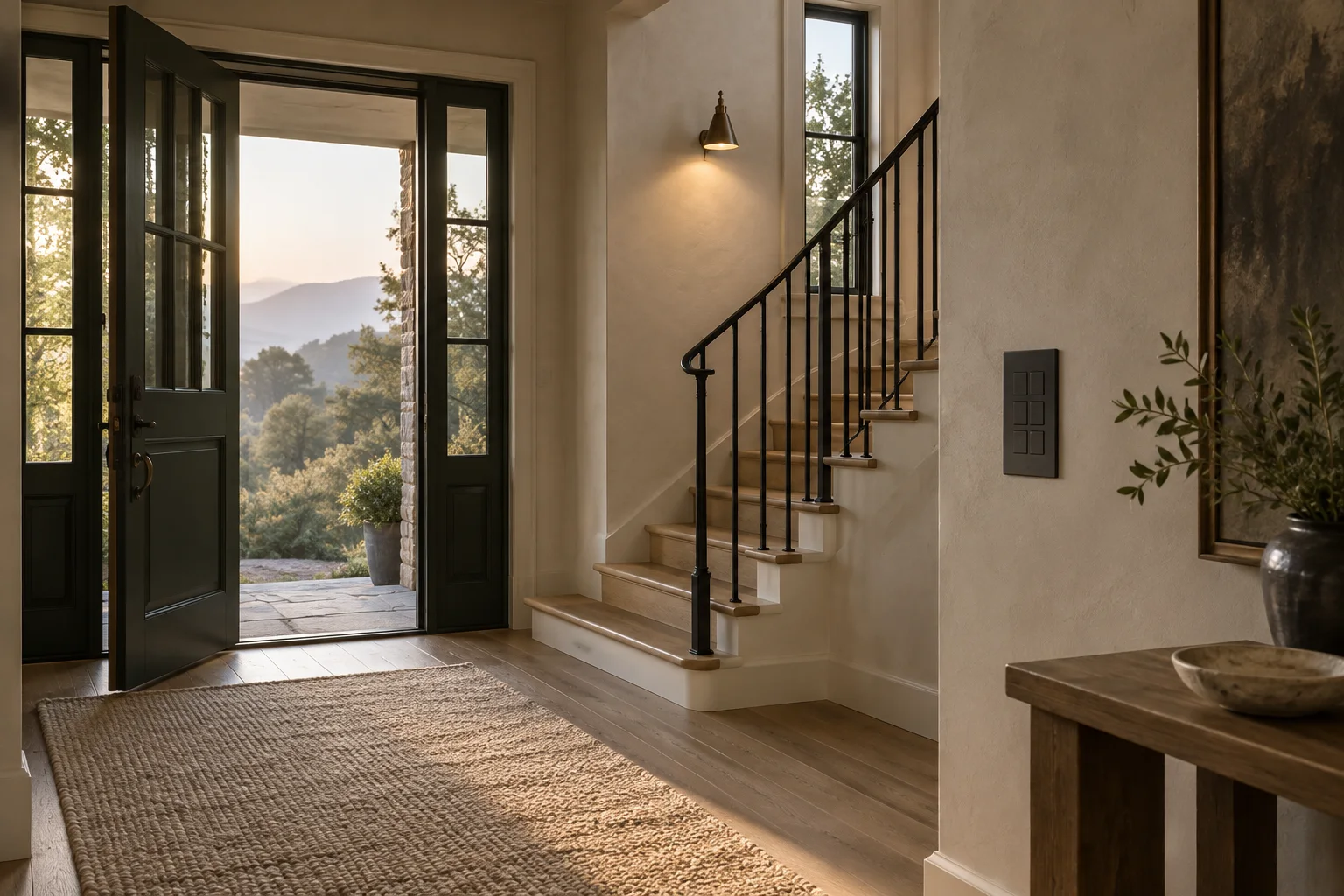
The most useful technology often begins with the everyday moment at the door.
This journal is a place to explore that idea. We will share useful planning thoughts, product context, and the questions worth asking before an installation begins. To start, here is a calmer way to think about what a smart home can be.
A smart home is a feeling, not an app
The first measure of a connected home is not the number of products in it. It is whether it feels natural.
Consider the moments that already shape a day. Waking up. Leaving in a hurry. Carrying groceries through the door. Reading after dark. Hosting friends. Locking up for a weekend away. Arriving at a mountain home after a long drive. Those are the moments worth designing around, because they have a rhythm before technology ever enters the picture.
In a considered system, a single action can take care of several small decisions: a “goodnight” control might lower the downstairs lights, close compatible shades, set the home for the evening, and leave the route to bed gently lit. A “welcome” scene can make an empty house feel ready without asking anyone to open four different apps. The point is not to impress a visitor. It is to remove little bits of friction from a routine you repeat hundreds of times.
That is why the best starting question is rarely Which brand should I buy? It is What would you like home to do more gracefully?
Start with the life already happening there
Every home has its own patterns. A family may want the kitchen, entry, and outdoor spaces to work beautifully when everyone arrives at once. A couple may care most about quiet evening lighting, music that follows them from room to room, and shades that respond to the sun. A second-home owner may want dependable visibility into access, temperature, and water concerns between visits.
Write down three moments you would genuinely like to improve. Be specific. “Better lighting” becomes “soft light in the hall before sunrise, without lighting the whole house.” “More security” becomes “know who is at the door and make it easy for a trusted guest to enter.” “Music everywhere” becomes “one simple way to play music in the kitchen, living room, and patio.”
Those details help turn a vague wish into a useful brief. They also keep a project from becoming a grab bag of disconnected products. A room can be intelligent without being complicated when its controls, lighting, comfort, entertainment, and access decisions have a shared purpose.
The invisible work makes the visible experience better
Many of the most important smart-home choices are not especially glamorous. They live in the background: a reliable home network, thoughtful equipment locations, sensible cable routes, shade power planned before finishes are complete, and physical controls that make sense at the wall.
Think of the network as the house’s quiet utility. Video calls, streaming, security cameras, voice services, phones, speakers, and connected controls all depend on it in different ways. A beautiful keypad cannot compensate for patchy Wi-Fi, and a clever automation cannot feel seamless if the system beneath it is unreliable. In new construction and renovations, this is the time to discuss wiring, access-point locations, and the space required for equipment. In an existing home, the conversation is about what can be added carefully while respecting the home’s finishes and structure.
The result does not need to look technical. In fact, it should usually look like it belongs there.
The best controls are the ones people already understand
An app is useful. It is not a complete answer.
Most people reach first for a familiar wall control, not a phone. Guests should be able to turn on a light without an orientation. Children, relatives, and anyone staying in the home should not need to borrow an account just to make the room comfortable. A well-planned smart home keeps ordinary actions ordinary: switches still work, keypads are clear, remotes are purposeful, and a scene makes sense from its name.
Voice control can be helpful when hands are full. Schedules can be helpful when a pattern is predictable. Mobile access can be helpful when you are away. Each is a useful layer, not a replacement for the simple controls that make a home legible to everyone in it.
This is also where good design earns its keep. Technology should respect how a room is used, where someone enters it, what can be seen from a bed or sofa, and which controls deserve to be immediate. The system should feel like part of the architecture and the routine, not an accessory attached afterward.
Connection should not mean confusion
Smart-home technology has grown quickly, and compatibility language can make it sound more complicated than it needs to be. There are platforms, protocols, hubs, accounts, subscriptions, wired and wireless products, and a growing set of interoperability standards. Those details matter, but they should be handled with care—not handed to the homeowner as homework.
A thoughtful plan begins with the systems that genuinely need to work together. Lighting and shades might share scenes. Audio may be part of entertaining and relaxing. Entry, cameras, and alerts may be coordinated around access. Climate can support comfort in rooms that heat up in afternoon sun. Not every device needs to be part of every routine; coordination is most valuable when it serves a real behavior.
It is also worth asking what happens when a phone is unavailable, the internet is interrupted, or a future product is added. No system is completely immune to change, but clear answers about everyday local controls, account ownership, subscriptions, documentation, and support make a home easier to live with over time.
A good first phase can stand on its own
There is no rule that says a smart home must be completed in one ambitious project. A focused first phase can be the wisest move: a strong network foundation, lighting and shades in the rooms used most, a more welcoming entry, or entertainment that finally feels effortless.
The important part is that the first phase has a clear outcome and does not close off good options later. If a renovation is opening walls today, planning a pathway or power provision for a future shade may be worthwhile even if the shade itself is a later decision. If the home needs stronger Wi-Fi now, a well-placed network can support other improvements as they become useful. Phasing is not about postponing a plan; it is about making each step purposeful.
A more considered home begins with better questions
The world of smart homes is full of possibility, but the best projects start quietly. Notice where the day asks you to do the same small thing again and again. Notice where a room is almost right, but not quite. Notice where being away from home creates uncertainty that a well-designed system could ease.
Bring those observations to the conversation. Along with floor plans, photos, existing equipment, and your project timing, they are the raw material for a home that feels unmistakably yours.
The aim is not more technology for its own sake. It is a home that knows when to help, and when to stay out of the way.