AI is changing how homeowners ask for things. A well-designed smart home still needs a dependable way to carry those requests out. For homeowners considering AI smart home automation in North Georgia, that distinction matters more than the name of the assistant.
A conversational interface can make technology easier to approach. It cannot, by itself, make incompatible shades work with a lighting system or fix unreliable Wi-Fi. The best starting point for a late-2026 upgrade or a 2027 installation is a clear plan for the home beneath the conversation.
What does AI actually add to a smart home?
There are three different ideas often grouped under the same label: understanding a spoken request, helping someone write an automation, and using information from sensors to decide what should happen. A product may offer one without offering the others.
Google's current documentation provides a useful example of AI-assisted setup. Its Help me create feature generates automations from a homeowner's description, but supported devices and actions still determine what can run. Google also lists a Home Premium subscription requirement for that feature. This is an example of a particular ecosystem, not a promise that the same functions are available in every professionally installed system. See Google's supported automation behaviors and limitations.
Think of the conversational layer as another way to interact with your home. Lighting circuits, network connections, device integrations, and carefully chosen rules remain the foundation.
AI assistants versus programmed home automation
A programmed scene is a set of defined actions. A dinner scene might lower selected lights, close compatible shades, and start music at a comfortable volume. Once configured, a wall button can recall that scene without anyone inventing a new instruction.
An AI assistant can make requests feel more natural or help turn an idea into a proposed routine. The homeowner should still know which devices the routine controls, when it will run, and how to stop it. An assistant's fluent answer is not proof that every physical device completed the request.
For a luxury home, both approaches can have a place. A clearly labeled keypad is often the easiest option for guests. Voice can be useful when your hands are full. An app can provide more detailed control. Choosing several sensible controls makes the house easier to live in.
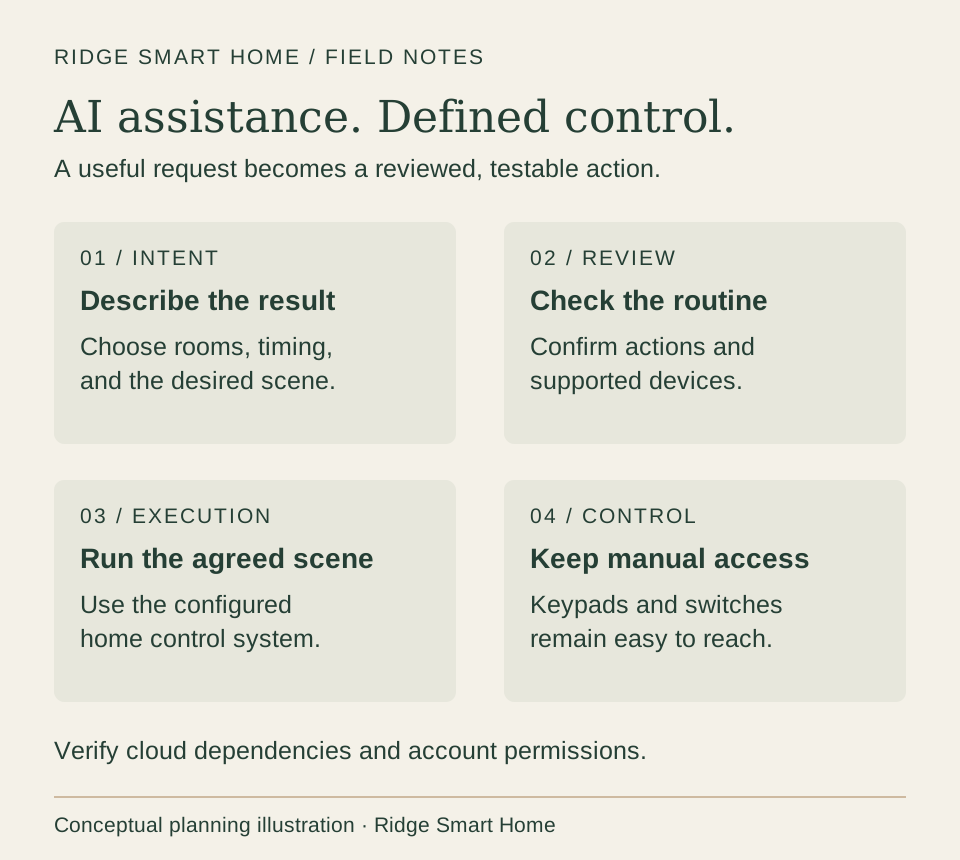
An AI-assisted request should lead to a defined, testable action. Physical controls remain part of the design.
Three practical AI automation briefs for North Georgia homes
Everyday living in Canton and Woodstock
For a household in Canton or Woodstock, start with an evening routine: selected lights at agreed levels, shade positions appropriate to the room, and optional music. Describe the result you want before choosing an assistant. Decide whether a time schedule, a keypad, or a spoken request should start it. Also decide what happens when someone adjusts a light manually.
A home office in Kennesaw
A Kennesaw smart home may need a work scene that keeps lighting consistent and separates office audio from the rest of the house. AI-assisted setup could help express the idea where supported; the actual design still needs defined rooms, compatible devices, and a reliable network. Avoid routines that interrupt a meeting because another room changes state.
Arrival at a mountain retreat
For a second home in Ellijay, Blue Ridge, or Jasper, an arrival scene can coordinate lighting and an appropriate comfort setting. Keep door access separately controlled and verify the status of each system. Remote requests depend on the chosen products and their connection requirements; they do not establish that someone has physically checked the property.
Questions to ask about privacy, internet access, and control
Before approving an AI feature, ask where requests are processed, what information is retained, and which account owns the configuration. Identify any recurring subscriptions and what functionality disappears if one is canceled. These answers vary by product and should be documented for the specific installation.
Then ask for an internet-disconnection demonstration. Which keypads, schedules, and room controls continue to work? Which features need a cloud service? A local controller does not automatically make every connected product independent of the internet. Ridge's home network and Wi-Fi planning should be considered alongside the automation design.
How should you test an AI-enabled home?
Write down a few requests you would actually use, including a request that the system should decline or cannot complete. Try them with different household members. Check room names, response timing, manual overrides, and the result after a device is unavailable. Review any AI-generated routine before relying on it daily.
Use a simple acceptance rule: everyone should be able to understand what happened and regain control. If an automation creates more uncertainty than convenience, simplify it.
Is AI required for whole-home automation?
No. Well-planned lighting, shading, climate, audio, and access integrations can deliver substantial convenience through scenes and schedules. AI is an optional capability to evaluate against your priorities, not a requirement for a premium home.
Can AI work with Savant, Control4, Crestron, or KNX?
The answer depends on the exact controller, interface, integration, and product versions. A brand name alone is not a compatibility specification. Ask for a demonstration of the proposed combination rather than assuming a consumer assistant can control every feature of a professional system.
Ridge Smart Home designs whole-home automation around the way you live. Start a conversation about your home to define useful AI features, dependable everyday controls, and a clear path for future upgrades.
Technology references checked October 7, 2026. Features, subscriptions, and availability can change; confirm the proposed configuration before purchase.